






Slot Machine Psychology: Near-Misses, Reward Loops, and Player Behaviour

Understanding the psychology behind slot machines is key to explaining why these games are so popular and engaging. Even though every outcome is randomly generated by RNGs, many factors shape how players perceive wins, near-misses, and rewards.
This guide looks at elements such as uncertainty, randomness, perceived control, visual and audio feedback and game pacing, among others.
How Do Uncertainty and Random Outcomes Influence Slot Machine Play?
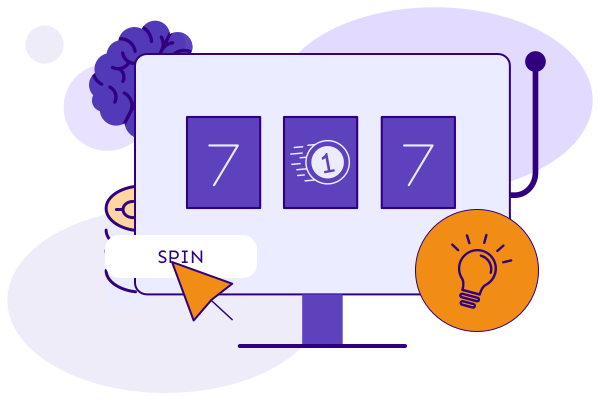
The connection between uncertainty, randomness, and slot play comes from a basic mechanism in behavioral psychology: uncertain rewards tend to sustain repeated behavior more effectively than predictable rewards.
What does this mean?
Players are more likely to repeat an action when they don’t know when the reward will come. On the other hand, if a reward is predictable, the motivation would most likely drop.
Let’s sum this up into 5 key mechanisms that explain this effect:
- Variable rewards
Players are particularly drawn to unpredictability, because the next attempt could possibly be a winner. - Response to uncertainty
Humans are highly sensitive to uncertain rewards. The more uncertain the reward is, the higher the attention and anticipation are. - Pattern recognition
It’s a part of human nature to look for patterns in random events, which can make random sequences feel meaningful or structured. - Fast feedback loops
Slots provide immediate outcomes after each spin, which creates a rapid cycle of action and feedback that keeps the interaction flow. - Low cognitive effort
Slot machines require minimal effort or decision-making, which makes them easy to play.
While these psychological factors influence engagement, the actual outcomes are determined strictly by a Random Number Generator (RNG) to ensure game integrity. For a detailed breakdown of this technology, see our guide on how slot outcomes are generated.
Understanding the Near-Miss Effect
In order to explain what is behind the players desire to play slots, the term that is simply crucial is the near-miss effect.
A near-miss happens when a spin results in a combination that appears visually close to a win, such as two identical symbols on a payline with a third symbol appearing just above or below the target.
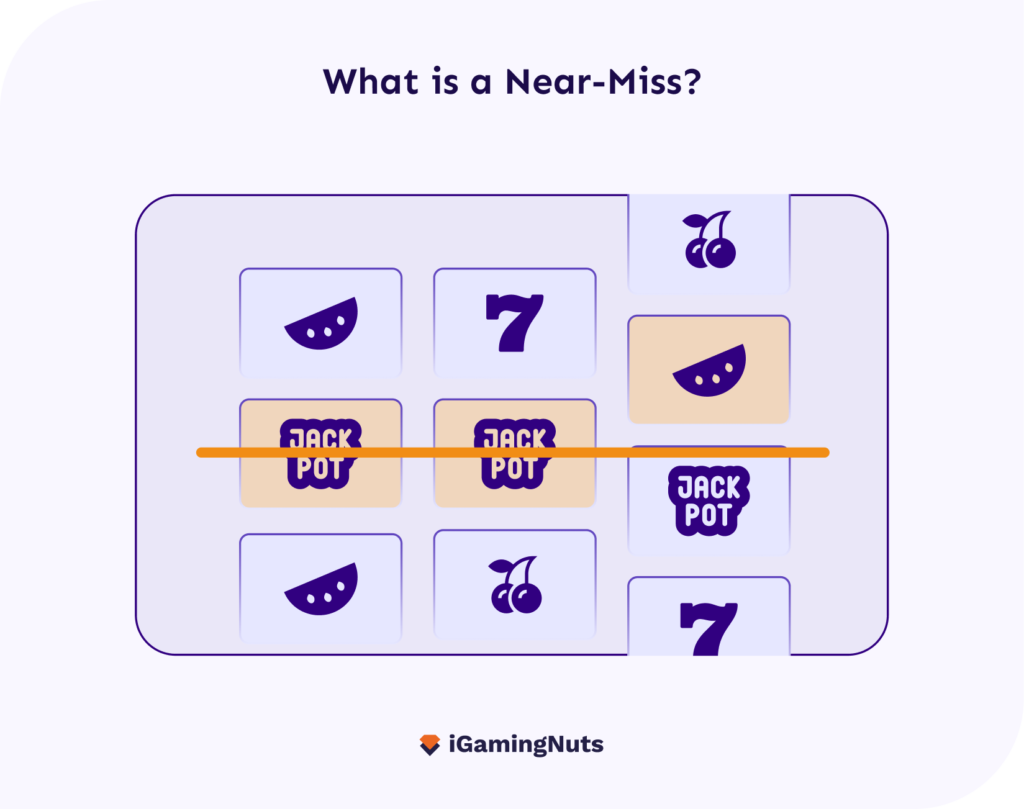
While a near-miss is mathematically identical to any other losing spin, players often perceive it as a ‘close’ event. From a design perspective, this creates a sense of proximity to a win, which can influence how a player perceives the game’s slot volatility and the likelihood of future outcomes, even though every spin remains independent.
How Do Reward Structures and Feedback Loops Work?
Slot machines use structured reward systems to communicate outcomes clearly to the player. Every spin produces a result, which the machine immediately signals to the player via visual and audio feedback. Animations and sounds typically announce the wins.
This process forms a feedback loop. The player performs an action, such as pressing the spin button, after which the system generates a random outcome, and the machine shows the result. Because the response appears instantly after the action, the connection between the two feels direct.
An important concept related to this structure is intermittent reinforcement. In behavioural psychology, intermittent reinforcement describes a situation where rewards appear at irregular and unpredictable periods of time rather than after every action. Instead of receiving a reward consistently, it may appear occasionally and without a predictable pattern.
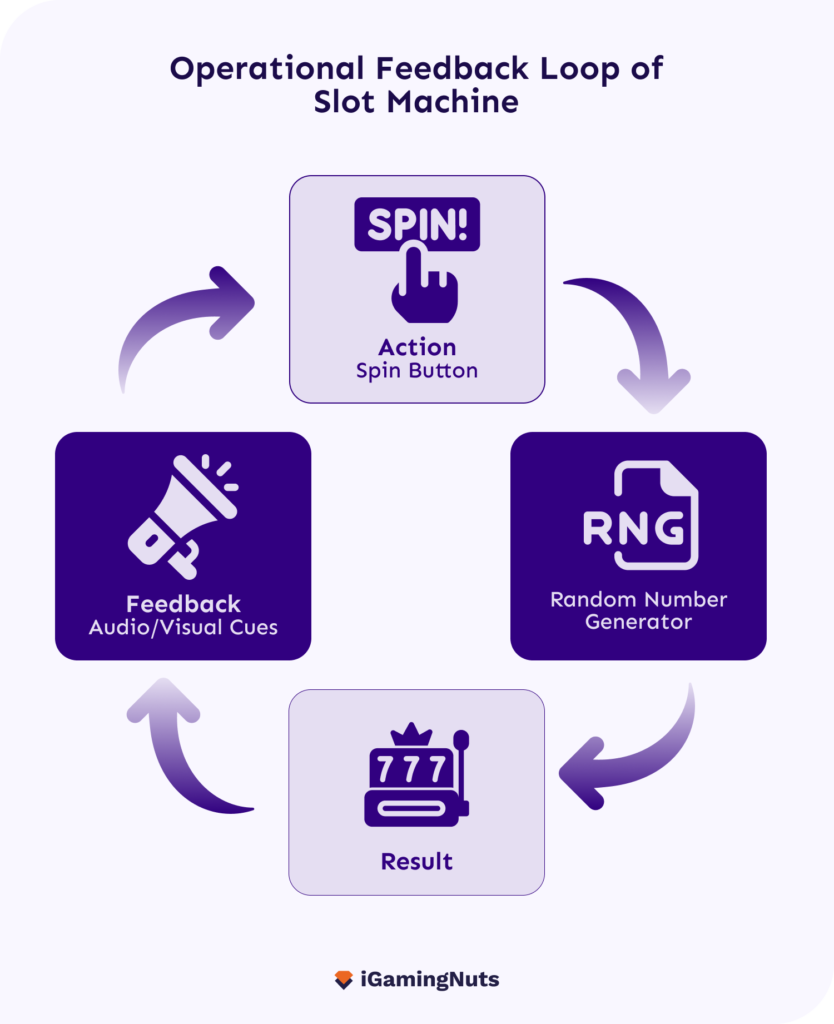
In the context of slots, slot machines operate within a similar structure because outcomes are generated randomly, thanks to RNG. From the player’s perspective, wins happen irregularly. One spin may not produce a reward, while another may result in a payout. Since players cannot predict when the next reward will appear, each new spin is uncertain and therefore more exciting. This player experience should not be confused with actual RTP percentages, which describe the theoretical long-term return of a game rather than what happens in a single session.
This combination of random rewards and immediate feedback creates a repeating interaction cycle. The structure does not change the slot randomness, but it shapes how players experience the outcomes during play.
What is the Role of Visual and Audio Presentation in Slots?
The role of visual and audio presentation in slots is enormous, since it shapes players’ perception.
The proof for that comes from a widely cited experiment by M. J. Dixon from 2010. It showed that sounds and animations in slot outcomes increase physiological arousal in players.
More research from the same group of authors suggests that sound significantly shapes how players perceive slot game outcomes.
It highlights how slot machines use both sound and visual elements to enhance the player experience. Wins are accompanied by distinct sounds, such as a foghorn for specific symbols, and a rolling or counting-up sound as credits increase, with longer sounds for larger wins. Visual effects like highlighting winning symbols or additional animations appear alongside these sounds.
After losses, the machines pause the visual and audio effects, which creates a contrast with wins. The research shows that players often interpret outcomes that come with different sounds as wins, even when they actually lost money on the spin.
What does this indicate?
Players do not react only to the mathematical result of a spin. The presentation through sounds, animations, and visual cues strongly influences their reaction.
In other words, presentation affects interpretation. These design approaches also vary across slot providers, with different studios using their own visual style, sound design, and feature mix to shape the overall experience.
Perceived Control and Interaction
Slot games work in a way to create a sense of control through buttons, choices, and pacing, even though outcomes are random. Players can press spin buttons, select bet sizes, or trigger bonus features, which gives them the impression that their decisions can influence results.
Some bonus features like picking symbols or optional paylines further affect this feeling, although the outcomes are still predetermined. This provides the illusion of skill or strategy.
Why Are Game Pacing and Feature Design Important?
Game pacing and feature design are important because they control the rhythm of play, keep player’s attention, and make sessions engaging.
Game pacing refers to how quickly spins, animations, and bonus events occur during gameplay. Spin duration, visual effects, and bonus features control the rhythm of play.
There are standard and quick-spin models. If you need a broader gameplay perspective, see our guide on how to play slots.
- Standard spins are well-known and follow a predictable sequence:
- Initiating spin
- Animating reels
- Displaying results
- Quick-spins reduce downtime between spins and are famous for extra features like sticky wilds, re-spins and unlockable rewards, along with high RTPs. Many of these mechanics can also be explored through demo slot games, which let players see how pacing, features, and feedback loops work without staking real money.
Bonus rounds or mini-games interrupt the regular flow and provide variation. Studies in HCI and gambling psychology indicate that fast, structured pacing combined with intermittent features keeps players attentive and immersed.
Psychologist Mihaly Csikszentmihalyi describes the concept of flow, as ‘’a state of complete immersion, intense focus, and enjoyment in an activity’’, which in a gaming context refers to the seamless transition between spins, animations, and results. This structured pacing is designed to maintain a consistent level of engagement with the game’s interface.
How Do Design and Responsibility Differ?
Some modern formats, such as Megaways slots, use changing reel layouts to make gameplay feel more dynamic without altering the underlying randomness.
The point of distinguishing design from responsibility is to clarify what the game does versus what the player does. At a deeper level, this distinction matters because it separates psychological influence from operational boundaries.
Slot machines are made to be engaging: sounds, visuals, pacing, and interactive features draw attention, signal rewards, and create anticipation. These design choices shape how the play feels, but they cannot change the randomness of the outcomes. Without this distinction, it’s easy to mix being drawn into the game with having control over winning, which is misleading.
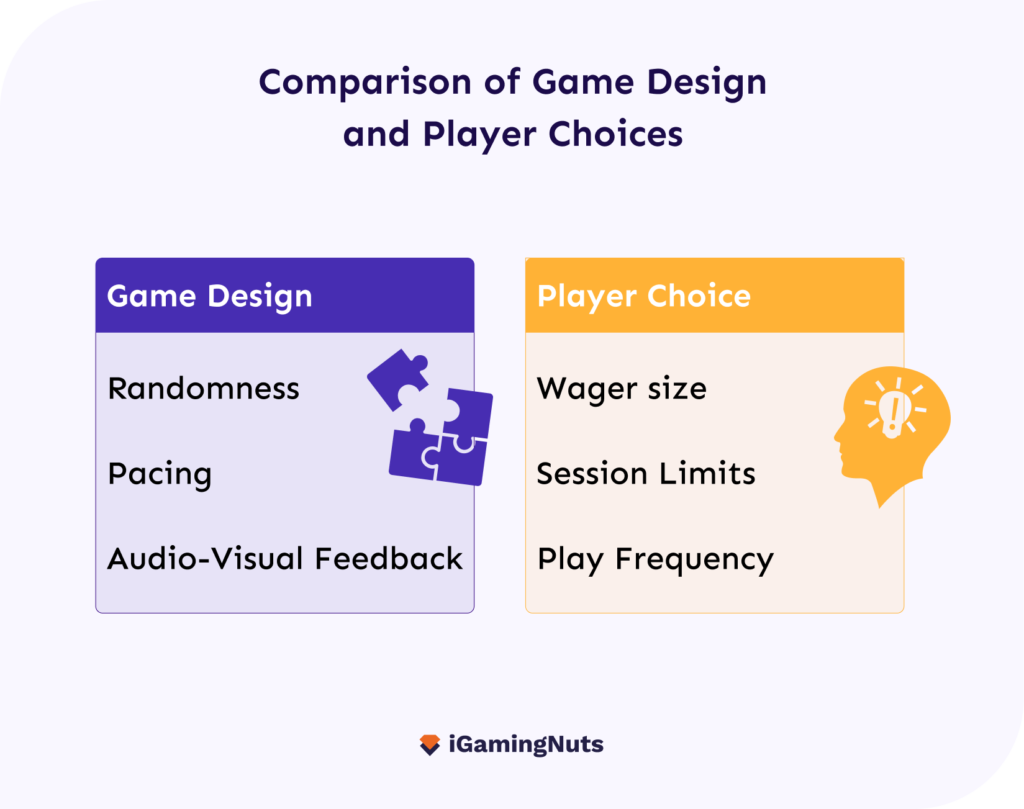
Responsibility is on the players’ side. They decide, manage their play, choose how long to play, how much to wager, and whether/when to stop. The distinction highlights that while design shapes how outcomes are perceived, it does not alter the mathematical probability of the game.
Making this distinction helps players understand the game and make informed choices. The excitement comes from the design, while decisions about limits, pacing and awareness are up to the player. It separates the way the game feels from the player’s responsibility.
Summary: Slot Psychology
Slot machines engage players by using core psychological mechanisms. Uncertainty, random rewards, immediate feedback, audiovisual effects, perceived control and pacing all combine to make slots popular.
The key elements of almost any game are the near-misses and intermittent reinforcement. Their role is to increase attention and keep players playing.
Players respond strongly to structured unpredictability, even when outcomes are entirely random. This shows that the allure of slots comes from the way the experience is constructed rather than the rewards themselves.
Taken together, these mechanics show how online slots combine randomness with design elements that shape player perception.
Slot Psychology FAQs
How do slot machines really work?
Slot outcomes are determined by random number generators (RNGs), which ensure that every spin is independent and unpredictable. The RNG continuously cycles through numbers, and the one selected at the moment you press “spin” determines the symbols that appear. This means that past results, patterns, or time spent playing do not affect future outcomes.
Can I control the outcome of a slot game?
No. Slots are governed by RNGs, which make each spin completely independent. Features such as bonus rounds, choosing paylines, or adjusting bets affect engagement and experience, but not the odds of winning. Many ideas presented as common slot strategies, such as waiting for ‘hot machines’ or tracking patterns, do not affect results because each spin remains independent.
What is intermittent reinforcement and why is it used in slots?
Intermittent reinforcement occurs when rewards appear irregularly and unpredictably, rather than consistently. In slots, this means wins are random, which keeps players engaged. Behavioral psychology shows that unpredictable rewards sustain attention and motivation way more effectively than predictable outcomes.
How do near-misses influence player behaviour?
A near-miss influences players’ behaviour in a way that the player believes the next spin brings a winning combination. While technically a loss, the player perceives the outcome as being close to a win. This visual proximity sustains engagement by suggesting that a winning result is possible on a subsequent spin.