


Something has shifted in the way Britons think about their summer holiday. For years, the default was simple: book flights, pack a bag, go abroad. This year, for a growing number of people, that calculus has changed.
A survey of 2,000 UK adults conducted in June 2026 found that around two-thirds of UK adults normally take a holiday abroad. Of that group, 43% say they are swapping their trip for a UK break this year.
Beyond escaping the ‘typical British weather’, the reasons they give are not hard to understand: airfares that have climbed well beyond pre-pandemic levels, a cost-of-living squeeze that has eaten into household budgets, and — for the first full summer — the friction of a new EU biometric border system that has already caused queues and disruption at major crossings. The holiday abroad, for a significant and growing slice of the population, simply no longer adds up.
- 43% of Brits who normally holiday abroad are swapping for a UK break this year — that’s more than a quarter of all adults.
- Switchers expect to save £815 on average, and a third expect to save £1,000 or more.
- Airfares (73%) and the cost-of-living squeeze (68%) are the top reasons, with 41% also citing new EU border checks.
- Yorkshire & the Humber is the most switch-happy region (34%), ahead of the East Midlands (32%) and Scotland (31%).
- Britain’s best-value staycation (Skegness) costs around £1,050 for a family week, against nearly £2,960 for the priciest (St Ives).
Airfares, the cost of living, and EU border queues: why Britons are staying home
Ask the people who are making the switch why they’re doing it, and the answers cluster quickly around two themes: it costs too much to go, and getting there has become more of an ordeal than it’s worth.
Among the 803 adults who said they were swapping or seriously considering swapping a holiday abroad for a UK break, nearly three-quarters (73%) cited the cost of flights and airfares. A figure almost as high — 68% — pointed to the cost-of-living squeeze on their budget. These two are the engine of the shift, and they are not independent: for many households, rising airfares land on top of grocery bills, energy costs and mortgage payments that have all moved in the same direction.
Almost half of switchers (48%) also cited the hassle of flying and airports as a factor — a broader category that includes delays, cancellations and the general friction of air travel that the pandemic-era disruptions made familiar and that has not fully resolved. Worries about specific delays or cancellations were named by 30%.
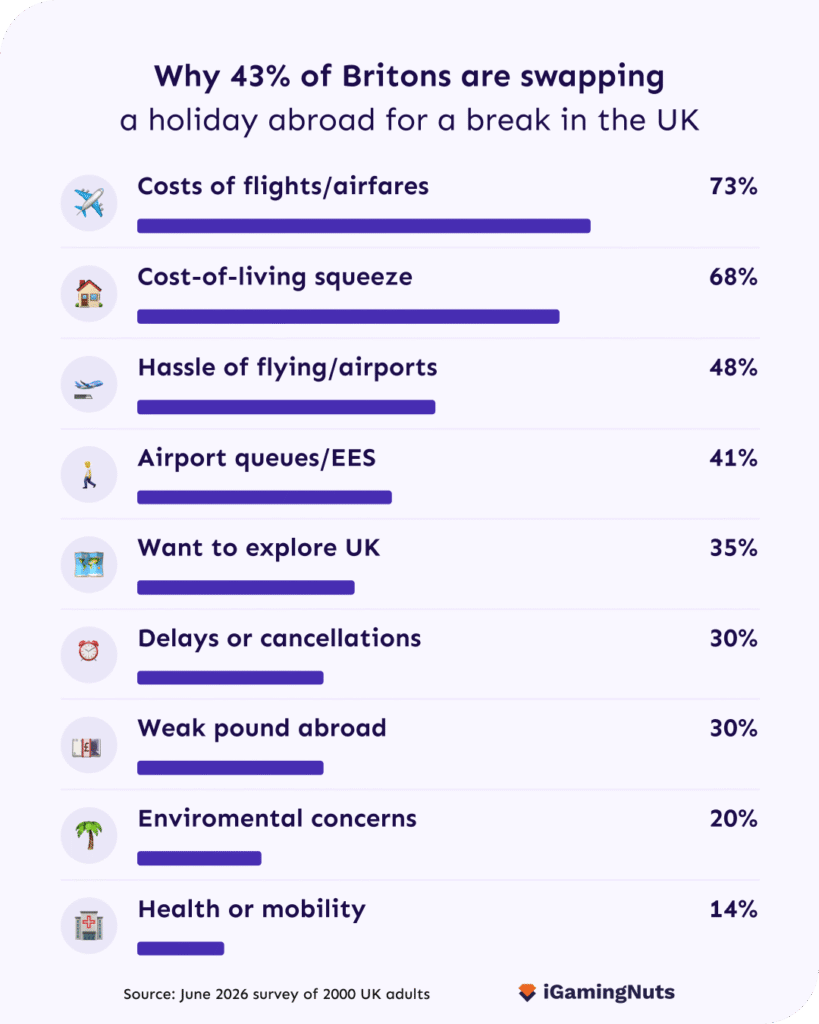
Then there is the new border system. Four in ten switchers (41%) cited airport queues and EU border checks as a reason they were staying home — a figure that speaks directly to this summer’s news. The EU’s Entry/Exit System (EES) became fully operational on 10 April 2026, making this the first complete holiday season under the new biometric checks that require UK travellers crossing into the Schengen area to register fingerprints and a facial image. Early weeks of the rollout brought documented disruption: Greece suspended EES checks for UK visitors in May 2026, checks were paused at points in Lisbon and Dover, and the UK government’s own travel guidance warned of longer waits at affected border crossings. Half of all UK adults (51%) say they are concerned about longer queues this summer as a result — 19% very concerned, 33% fairly concerned.
The appeal of the UK itself is also part of the story, if a secondary one. A third of switchers (35%) said they wanted to explore more of Britain; 30% pointed to the weak pound making spending abroad more expensive; 20% cited environmental concerns; and 14% gave health or mobility reasons.
What they expect to save — and what they feel they’re giving up
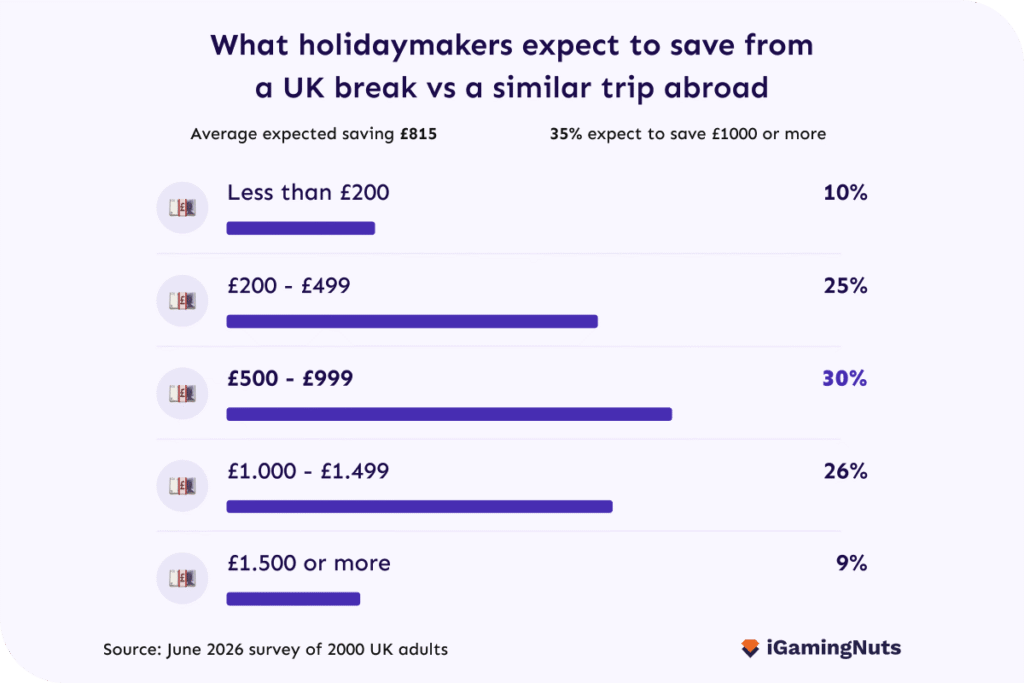
The financial logic of the switch is clear in the numbers. Among those who gave a figure, the average expected saving from taking a UK break instead of going abroad is around £815. A third (35%) expect to save £1,000 or more. The most common single response band — chosen by 30% — was £500 to £999, suggesting a substantial and widely-felt saving rather than a marginal one.
The trade-off, though, is real. When UK holidaymakers were asked what they give up most by not going abroad, the top answer — by some distance — was guaranteed sunshine and warm weather, cited by 42%. The honest truth of the British summer is embedded in that number: money and hassle may tip the decision, but the sun is what most people are actually giving up.
What is striking is how many do not feel they are giving up much at all. The second most common answer, chosen by 22% of UK holidaymakers, was nothing — they are happy holidaying in the UK regardless. A further 20% said they give up the sense of escape or being somewhere different, 10% a particular destination or culture, and 7% cheaper food and drink abroad.
Who is switching most — and where the pressure is sharpest
The Staycation movement is happening across the country, but not evenly. In Yorkshire and the Humber, 34% of all adults say they are swapping a holiday abroad for a UK break this year — the highest rate of any region. The East Midlands follows at 32%, then Scotland at 31%, the South East at 29% and London also at 29%. At the other end, the North East and Northern Ireland each show rates around 22%, though sample sizes for smaller regions are modest and those figures are best read as indicative rather than precise.
Where the switch is sharpest — adults swapping a holiday abroad for a UK break:
- Yorkshire & the Humber — 34%
- East Midlands — 32%
- Scotland — 31%
- South East — 29%
- London — 29%
- North West — 28%
- West Midlands — 27%
- East of England — 27%
- South West — 26%
- Wales — 24%
- Northern Ireland — 22%
- North East — 22%
Among adults who normally holiday abroad, parents of children under 18 are switching at a higher rate than non-parents — 48% versus 41%. The fixed window of the school holidays, which forces families to travel abroad at peak prices, makes the financial case for staying home sharper for parents than for anyone else.
Where to go if you’re staying home: Britain’s best-value staycations ranked
For the four in ten adults who are switching or considering it, the next question is where to go — and how to make the most of the money they are saving. To help answer that, the research built a Destination Value Index: a ranking of 30 UK holiday destinations by the total cost of a 7-night stay in the peak August school-holiday window for a family of four (two adults, two children).
Four cost components were included: accommodation (seven nights self-catering or the equivalent), paid attractions (a basket of three representative family activities), food and drink (a week’s mix of self-catering and eating out), and parking where charged.
The result is a range that runs from £1,050 at the cheapest to nearly £2,960 at the most expensive — a gap of close to £1,900 for the same week away, in the same country, in the same month.
Skegness in Lincolnshire takes the top spot at around £1,050 for the week. It is followed by Great Yarmouth (≈£1,120), Bridlington (≈£1,135), Cromer (≈£1,205) and Whitley Bay (≈£1,245) — all traditional east-coast seaside resorts where self-catering and caravan accommodation keeps costs down, and the beach itself is free.
https://public.flourish.studio/visualisation/29546583
At the other end of the table sits St Ives in Cornwall at roughly £2,960, followed by Edinburgh (≈£2,425 — reflecting the August Fringe premium), the Isle of Skye (≈£2,290), the Lake District’s Windermere (≈£2,130) and Brighton (≈£2,095). These are destinations where demand in August significantly outstrips supply, or — in Edinburgh’s case — where a major festival pushes accommodation prices sharply higher.
The national average across all 30 destinations is approximately £1,667 for the week.
One quirk worth noting: Blackpool, which many would assume sits near the value end of the table, has some of the cheapest accommodation in the index but the highest attractions cost of any destination — the Pleasure Beach and the resort’s other paid attractions push the overall total into mid-table rather than the top 10 a cheap B&B might suggest.
Nearly three-quarters of UK holidaymakers (72%) said they would consider choosing a cheaper destination to save money — 39% definitely, 34% possibly. The index is the map of where those savings are.
About this research
The switch findings are drawn from a survey of 2,000 UK adults conducted in June 2026. Around two-thirds of UK adults normally take a holiday abroad. Of that group, 43% say they are swapping their trip for a UK break this year.
The UK Destination Value Index models the total cost of a 7-night peak-August holiday for a family of two adults and two children across 30 UK destinations. Four components are included: accommodation (seven nights, self-catering or family room at mid-range rates), paid attractions (a basket of three representative family activities), food and drink (a week’s mix of self-catering and eating out), and parking (seven days where charged). Destinations are ranked by total cost; lowest total = rank 1. Figures reflect modelled 2026 peak-season prices. The Isle of Wight cost estimate does not include the vehicle ferry crossing.