


Still Touching Wood: Britain’s Superstition Index

The United Kingdom may be in superstition denial. See, when you ask a Brit if they’re superstitious, they’re likely to say no. But when you ask that same person if they touch wood for luck, there’s a good chance they’ll say yes. Half of UK adults will tell you, hand on heart, that they are not superstitious. They’ll tell you this while avoiding the number 13, wearing their lucky pants to a job interview, and refusing to put new shoes on the table. We wanted to learn more about the superstitious habits of the United Kingdom, so we surveyed 1,800 UK adults. As it turns out, we’re not just a nation of non-believers. We’re a nation of people who say they don’t believe, but do so anyway. Just in case.
Key Takeaways
- 49% of Brits say they’re not superstitious, yet 89% of those same people follow at least one superstition.
- 1 in 5 Brits let superstition influence their wedding date.
- 27% have spent extra money because of a superstitious belief.
- London is the UK’s most superstitious region (46%), Yorkshire and the Humber the least (37%).
- Only 22% of the population fully reject superstition as nonsense.
Where Superstition Runs Deepest
When asked to describe their overall relationship with superstition, the single most popular answer was “I don’t really believe, but I follow some habits just in case”, chosen by 42% of respondents. Only 22% were willing to say superstition is complete nonsense. The rest of the country sits somewhere between quiet compliance and genuine conviction, with 30% saying certain superstitions have real truth to them and 8% calling superstition an important part of how they make decisions.
Superstitious belief isn’t evenly spread across the country. When we break the data down by region, we see who’s willing to own the label and who isn’t.
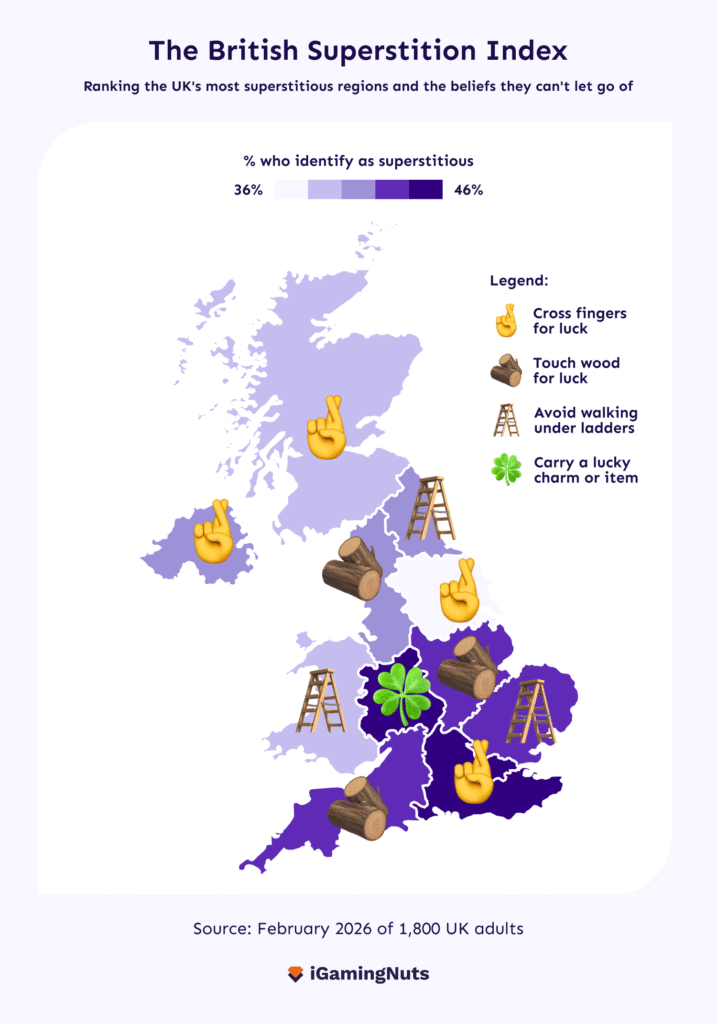
London is the UK’s most superstitious region, with 46.3% of residents identifying as superstitious. The West Midlands follows closely at 45.9%, then the South West at 43.9% and East of England at 43.8%. At the other end, Yorkshire and the Humber is the least superstitious region at 36.5%, just behind the South East at 36.6% and the North East at 37%.
Each part of the country has its own superstitious personality, defined by whichever belief dominates locally. Londoners are most likely to cross their fingers for luck, a habit shared with Scotland, Yorkshire, and Northern Ireland. The North East, East of England, and Wales are the nation’s ladder-dodgers. The North West, South East, South West, and East Midlands all default to touching wood. And the West Midlands stands alone as the only region where carrying a lucky charm is the most popular superstition.
Why Are We Suspiciously Superstitious
Touching wood is Britain’s most common superstition, practised by 55.8% of the population. If you’re not familiar with this, touching wood is an action used to prevent bad luck or protect current good fortune. Crossing fingers sits just behind at 51.5%. Together, these two habits are followed by the majority of UK adults, making them feel less like superstition and more like second nature.
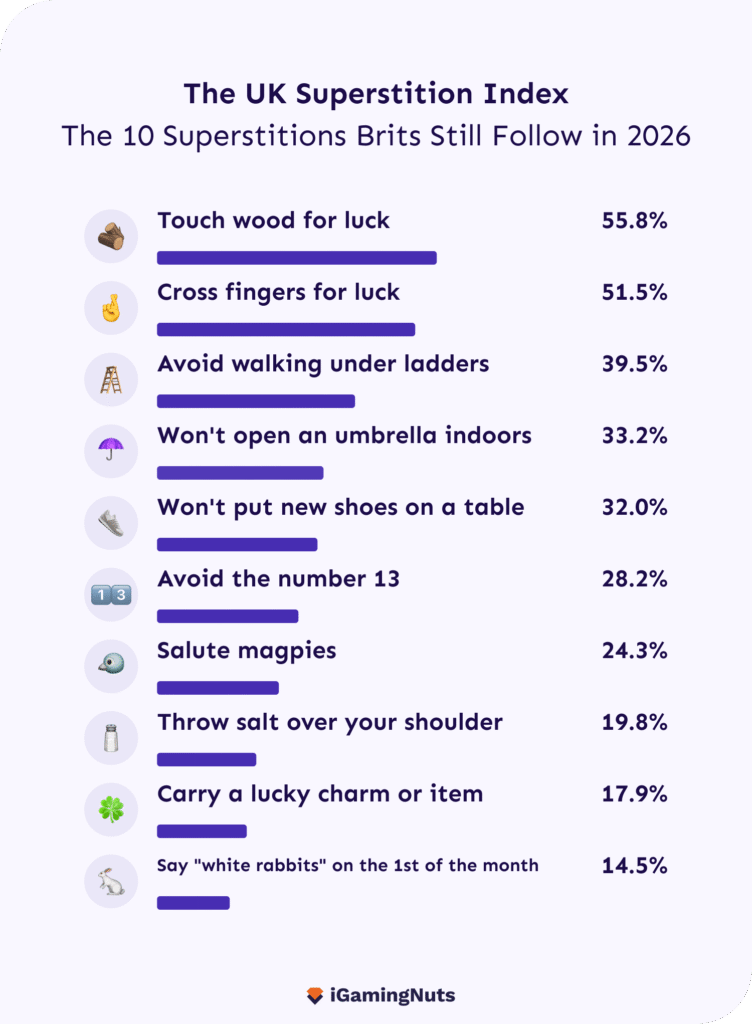
After that, the numbers drop but remain significant. Avoiding walking under ladders comes in at 39.5%, followed by refusing to open an umbrella indoors (33.2%) and not putting new shoes on a table (32%). Avoiding the number 13 is practised by 28.2%, and nearly a quarter of the country (24.3%) salutes magpies; so if you’re reading this from outside the UK, you might think we’re a crazy bunch…
Further down the list, 19.8% throw salt over their shoulder after a spill (in order to reverse the bad luck of spilling salt in the first place), 17.9% carry a lucky charm, and 14.5% still say “white rabbits” on the first of the month. Only 5.3% of respondents said they follow none of these superstitions at all.
Superstition Shapes Real Decisions
Everyday quirks are one thing. Letting superstition influence a major life decision is another. And the data suggests it happens more often than most people would expect.
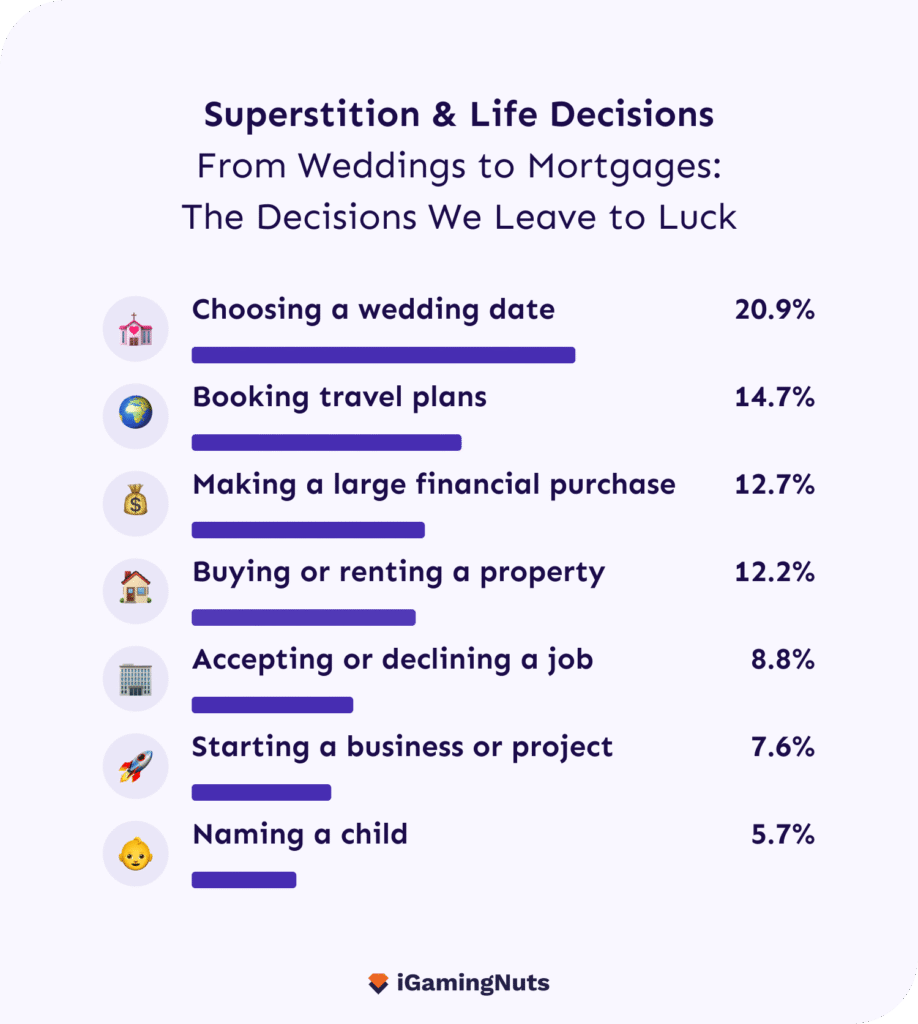
Over half of respondents (55.8%) say superstition has influenced at least one significant life decision. The most common is choosing a wedding date, with 20.9% of Brits saying superstition played a role. One in five couples, in other words, factored luck into one of the biggest days of their lives.
Travel plans are the second most affected decision at 14.7%, followed by large financial purchases at 12.7%. Property decisions, whether buying or renting, were influenced by superstition for 12.2% of respondents. That’s roughly one in eight people making what is often the largest financial commitment of their lives with at least one eye on luck.
Career decisions aren’t immune either. 8.8% say superstition affected whether they accepted or declined a job, and 7.6% say it influenced starting a business or project. Even naming a child was shaped by superstitious thinking for 5.7% of parents.
The Price of Luck
Superstitious beliefs aren’t free. Over a quarter of the country (27.2%) say they’ve spent more money, or turned down a cheaper option, specifically because of a superstitious belief. That includes paying extra for a luckier wedding date, avoiding a house with the wrong number, or choosing a more expensive flight to dodge an unlucky departure day.
When asked to estimate how much extra they’ve spent over their lifetime due to superstition:
- 50.4% said £0
- 14.2% said £1 to £50
- 9.6% said £51 to £250
- 5.2% said £251 to £1,000
- 2.1% said £1,001 to £5,000
- 1.2% said more than £5,000
- 17.2% have no idea
For most people, the cost is small. But for a significant minority, superstition has added hundreds or even thousands of pounds to life’s biggest decisions.
On the Pitch and in the Office
Sport brings out the superstitious side of the British public more than almost anything else. 63.8% of respondents follow at least one sporting superstition. The most common:
- 28.8% avoid saying certain things to not “jinx” the result
- 20.8% sit in the same seat or spot every match
- 16.7% wear a lucky item of clothing or kit
- 13.4% follow a specific pre-match routine
- 13.1% use lucky numbers for bets or predictions
The workplace is more restrained, but superstition still has a presence. Almost half (49.5%) follow at least one workplace superstition. Lucky outfits for interviews and important meetings are the most common at 18.9%, followed by specific rituals before presentations or big calls (15.1%). 13.9% avoid scheduling important tasks on Friday the 13th, and 11.2% keep a lucky object on their desk.
The Arguments Nobody Expected
Superstition doesn’t just affect individual choices. It creates friction between people. 34.9% of respondents say superstition has caused a disagreement with a partner, friend, or family member.
- 25.4% say it caused minor disagreements
- 9.5% say it caused tension over a significant decision
- 65.1% say superstition has never caused conflict
That means roughly one in ten Brits has had a serious disagreement where somebody’s lucky feeling clashed with somebody else’s logic.
Super(Duper)Stitious?
Perhaps the most surprising finding is that superstition appears to be getting stronger, not weaker. When asked whether their beliefs have changed over the past five years:
- 17.5% say their superstitious beliefs have increased
- 13.9% say they’ve decreased
- 45.6% say they’ve stayed the same
- 22.9% say they don’t hold any superstitious beliefs
More people are becoming superstitious than growing out of it. Britain in 2026 is not a country that’s leaving superstition behind. If anything, it’s quietly settling further into it. Touch wood it stays that way.
Methodology
This study is based on a February 2026 survey of 1,800 UK adults, conducted by iGamingNuts. The sample comprised individuals residing across the UK’s 12 standard regions (the nine English regions, Scotland, Wales, and Northern Ireland) to ensure regional representativeness. Respondents were asked 11 questions covering self-identification as superstitious, specific superstitious behaviours practised, the influence of superstition on major life decisions, financial impact, sporting and workplace superstitions, relationship effects, and changes in belief over time. Regional rankings are based on the percentage of respondents in each region who identified as superstitious. All percentages are rounded to one decimal place.