


How AI and Machine Learning Transformed the iGaming Industry in 2025

AI and ML are transforming and reshaping countless industries worldwide.
One of the sectors experiencing the most profound change is iGaming, where AI is driving innovation, personalization, and responsible gaming practices. One indication of how much the iGaming industry has grown thanks to AI is the fact that the global online gaming market is projected to be worth US$522.54bn by 2030, with an annual growth rate (CAGR 2025-2030) of 3.05%.
Today’s casinos and sportsbooks use ML on vast amounts of player data to optimize everything from content to security. In this article, we’ll explore how AI-driven personalization, advanced fraud/AML monitoring, responsible-gambling tools, and even generative AI for game design are affecting the industry. We will also look at how operators benefit and what challenges they may face. But let’s start with the basics.
What Are Artificial Intelligence And Machine Learning?
Artificial intelligence refers to systems and software that perform tasks which normally require human intelligence, such as reasoning, decision-making, pattern recognition and language understanding. It is a very broad field that consists of numerous subfields, like machine learning, NLP, robotics, etc.
In practice, AI in iGaming powers features like behaviour analysis and real-timesentiment analysis. The first one includes tracking observable behaviour such as clicks, scrolling, dwell time, purchase activity; in some cases even facial expressions, voice tone, etc.
The latter one is related to detecting and interpreting customer emotions like frustration, satisfaction or confusion. Those can be tracked via chat messages, social posts or call audio. Tracking emotions is crucial for excellent customer service and brand marketing.
In simple words: AI is the umbrella that uses many techniques to make sense of player actions and emotions so platforms can personalize experiences, improve support, and spot fraud faster.
Both real-time behaviour and real-time sentiment analysis are used in iGaming, and are deeply related to machine learning.
Machine learning is one of the numerous AI subfields. Here computer models learn patterns from data and make predictions or decisions without being explicitly programmed for every specific case. Instead of hard-coded rules, machine learning systems are trained on examples such as past games, player actions, text, voice, etc. and improve their accuracy over time.
Let’s see how machine learning and AI can prevent money laundering in real time.
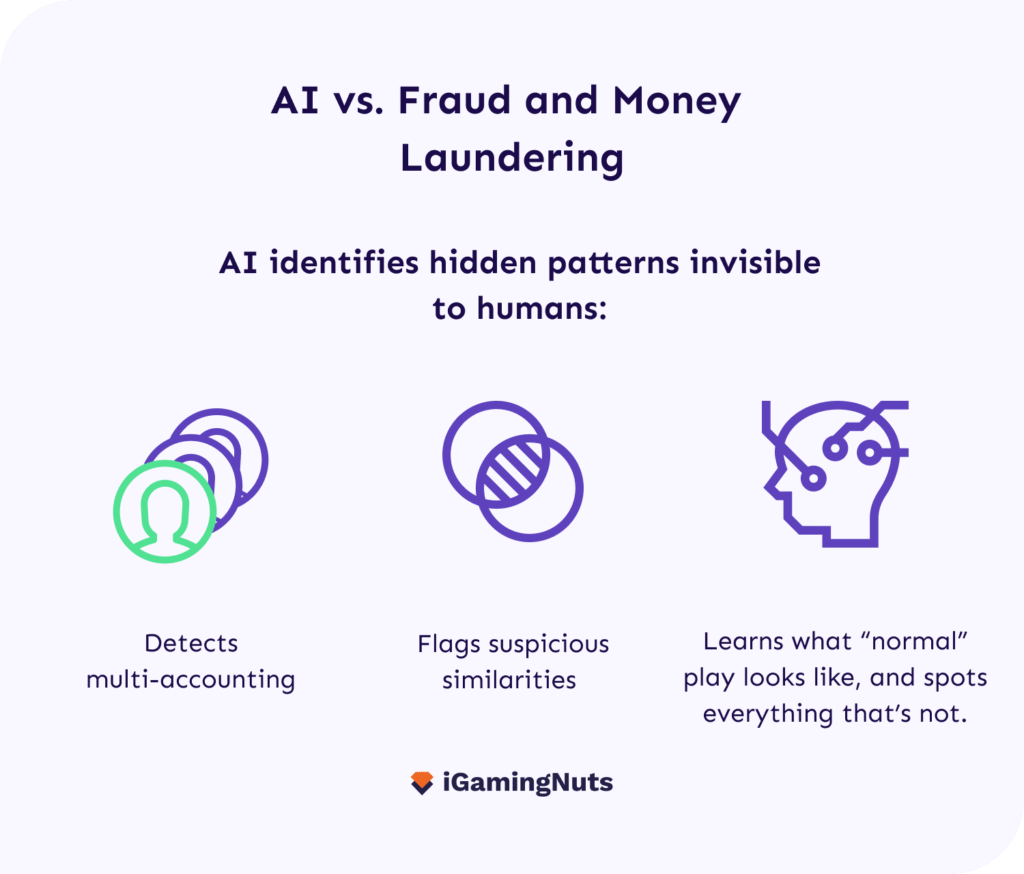
ML and AI Can Fight Fraud and Money Laundering in Real Time
Since there are major financial transactions going on in the gambling industry, prevention of possible frauds such as money laundering, are crucial for the industry. ML and AI can detect suspicious activities in real time and provide priceless help in stopping them.
There are numerous types of fraud in iGaming:
- Multi-Accounting
- Gnoming
- Bonus Abuse
Creating multiple accounts to exploit the bonus offers in different casinos, is one of the most common frauds out there.
Gnoming, on the other hand,is very similar to the previous one, and it is where a user creates multiple accounts pretending they belong to different players, by faking their personal data.
All these actions stem from, or contribute to, bonus abuse and therefore must be prevented.
How Can ML and AI Help Prevent This?
After the learning process, ML models can identify unusual patterns. For example, algorithms can detect similarities in device fingerprints, IP addresses, behavioral patterns, or transaction histories that would be difficult for a human to notice manually. AI systems can also track how players behave during gameplay, how they move through the site, the timing of their bets, and the way they interact with bonuses, to spot behavioral similarities between supposedly different users.
Over time, the machine will learn what a normal behaviour looks like, and flag accounts opposite of this.
Safer Play with AI-Powered Responsible Gambling Tools
Fraud and responsible gambling are two sides of the same coin. Apart from keeping operators safe, AI plays a vital role in player protection as well.
Licensed casinos in the UK, Europe and other countries, now incorporate ‘safe play’ into their software with AI. Platforms track how long a player plays, how much they bet, and whether their behavior changes (e.g. playing much later at night or rapidly increasing stakes). If an AI model detects risk indicators, for example a casual bettor suddenly doubles his deposits, the software can trigger a nudge or intervention. For instance, a prompt might say “Looks like you’ve been playing for a while, do you want to take a break?”. If things get more serious, AI can automatically enforce particular limits like a deposit or time limit, or even suspend the whole play until a human checks in.
Considering all this, one cannot help but ask whether AI will replace humans. Well, this is a debate of the century, but iIndustry veterans stress that AI will and should alert humans rather than replace them entirely. As Reuben Portanier (former MGA CEO) summarizes, AI “can ring the doorbell, but it must always be a trained human who opens the door, checks on the person, and provides support”.
The Benefits of AI in Game Development
Definitely one of the most obvious benefits of AI in gambling is its use in game design. One of its greatest advantages is the speed of making new visuals, audio, text and even core game algorithms. This is extremely valuable because it shortens the game design time and cuts its cost. This leads to operators publishing many more titles and localising content more quickly.
Here is a concrete industry example: in 2024, XGENIA launched a prompt-driven platform that can produce a slot in under 20 minutes.
Let’s not forget personalization in gaming, as another huge benefit of AI. It is extremely valuable as it has the power to accurately analyze player behavior to tailor challenges, bonuses, and other rewards based on players’ needs and interests.
For example, AI can adjust slot game volatility in real time based on a player’s behavior. In table games like roulette or blackjack, AI-powered bots can simulate realistic opponent strategies. AI can also generate adaptive storylines or bonus rounds in skill-based games, so each session feels unique and well-thought-out.
AI can even help in designing entirely new game mechanics and storylines based on players’ psychological characteristics.
In gambling, using AI, the system could analyze behavioral patterns, such as risk tolerance, reaction to near-misses, and then adjust the game mechanics accordingly. For example, a player who enjoys frequent small wins might see a slot with lower value payouts and engaging mini-bonus rounds. On the other hand, a player who is prone to taking risks might encounter higher volatility slots with bigger jackpots but fewer guaranteed wins.
It goes without saying that all this keeps players engaged and therefore increases retention.
Automating Marketing Processes
Speaking about AI in iGaming marketing, ML can optimize marketing spend by targeting high-value players, by identifying patterns and predicting players’ future actions.
On the other hand, AI can automate many repetitive tasks. Automating routine tasks is a must not only in iGaming, but in almost every industry that relies on online presence. Time saving is one of the greatest benefits AI has brought us.
Apart from that, let’s not forget the real-time behaviour analysis. With it, marketing experts can predict the likelihood to make a conversion.
Let’s check out other real use cases of AI in marketing:
- Grouping audiences to create live segments based on how players behave and respond to campaigns
- Spotting ad fatigue to flag ads that are losing effectiveness before performance drops
- Testing new ads automatically by using real results to improve performance
- Predicting customer value to focus budgets on users that are most likely to convert and stay. Beyond automation, player retention remains the cornerstone of sustainable growth. Our recent analysis in Casino Loyalty Uncovered explains how loyalty programs and data-driven rewards can work hand-in-hand with AI-powered marketing strategies.
How Can AI help with Regulatory, Privacy and Ethical Challenges: GDPR Loop
Automated marketing can lead to potential breaches in terms of data collection and privacy, so let’s say a few words about this particular topic.
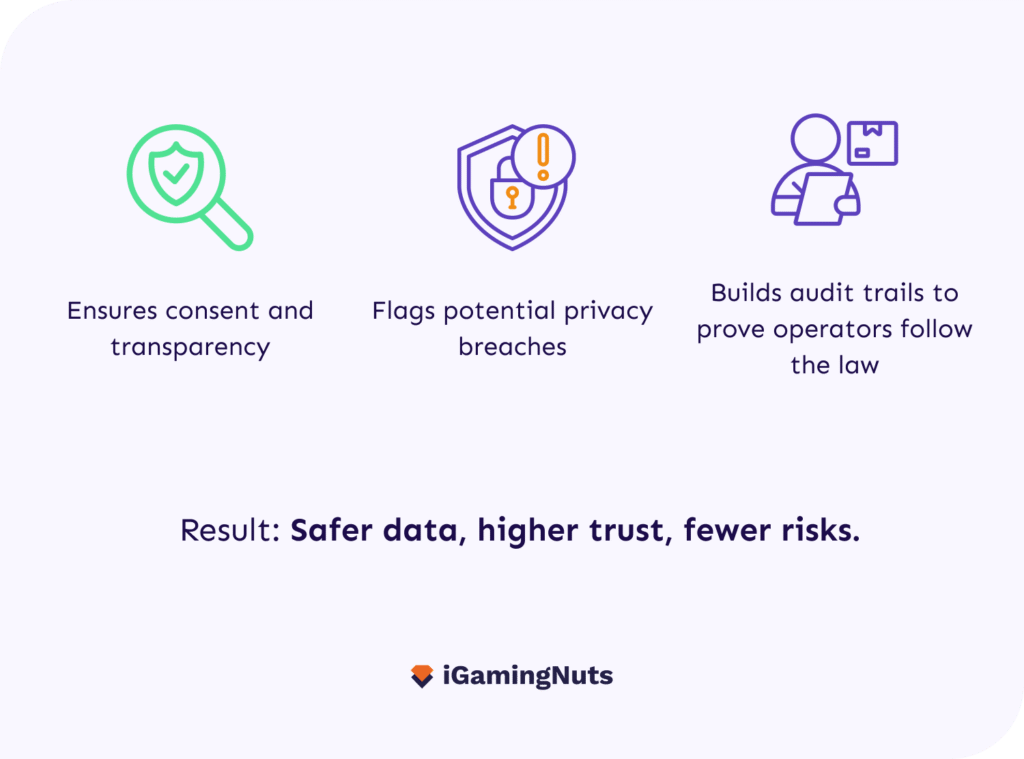
AI systems often rely on collecting and analyzing huge amounts of personal and behavioral data. The data can vary from gameplay patterns to deposit habits and device fingerprints. This, of course, raises privacy concerns. Compliance with laws like GDPR or local gaming regulations requires careful handling, secure storage, and clear consent mechanisms for player data.
GDPR compliance is a continuous cycle where data protection is actively monitored and enforced at every step. AI systems can help by automatically tracking how operators collect, process and store player data. They have to also ensure that all actions are aligned with GDPR rules.
They can flag potential issues, such as data being used without consent or retained longer than allowed, and generate audits to demonstrate compliance. By continuously checking, adjusting, and reporting on data usage, AI creates a proactive system that protects player privacy, reduces the risk of breaches, and ensures that operators act ethically at all times.
Speaking about ethical considerations, operators should make sure that AI-driven decisions about player accounts, bonuses, or access are clear and easy to understand, so players don’t feel manipulated or treated unfairly.
Predictive models can help identify valuable players or detect problem gambling, but without proper control, they might push players toward actions that don’t benefit them, but only the operator.
In summary, while AI offers powerful tools to enhance iGaming operations, its use comes with significant responsibilities. When done correctly and approached in a holistic way, AI not only enhances operational efficiency, but also reinforces player trust.
The Future of AI and ML in iGaming: Augmented and Virtual Reality
AI and machine learning are set to transform iGaming further when combined with augmented reality (AR) and virtual reality (VR). AR and VR are the future of online gambling although there were predictions that they were supposed to take over the iGaming industry 10 years ago. It hasn’t happened yet, but we can expect that the change is yet to come.
These technologies create 3D gaming environments, from virtual casinos and live table games to interactive slots, which has a potential to completely change the structure of gambling in general.
The real time personalization of player’ experience is something to think about. For example, AI can analyze a player’s behavior and adjust game difficulty or tailor the visual environment in a VR casino to match their preferences. In AR, ML can overlay contextual game suggestions or bonuses onto a player’s physical surroundings, creating a seamless blend of real and virtual play.
The benefits of this are countless. Players get more engaging, interactive, and personalized experiences, while operators can gather deeper behavioral insights from how users navigate virtual spaces and interact with objects.
Conclusion
In 2025, AI and ML have become the engine driving the iGaming industry forward. AI is reshaping how casinos and sportsbooks operate, and these changes vary from personalizing gameplay to detecting fraud in real time.
It can analyze player behavior to adjust slot volatility, simulate realistic opponents in table games, or even craft story-driven bonus rounds tailored to psychological profile.
On the operational side, AI streamlines marketing, automates routine tasks, and predicts player value to optimize spend. Crucially, it also helps enforce GDPR compliance and ethical practices, monitoring data usage, spotting risks, and flagging unusual patterns before they escalate.
In a nutshell, the gambling industry evolves faster than most entertainment sectors. Player expectations, data privacy laws, and technology standards are constantly changing. Needless to say, if operators fail to keep up with the times, they risk losing players to competitors in a game where staying ahead is everything.